Growing Pay TV: The Success Story of Mundo Pacífico with TVUP
The pay TV market in Chile is undergoing a phase of structural contraction. Over the past twelve months, the sector has recorded a 7.6% decline, accompanied by a widespread loss of subscribers and market share across most operators.
In this context, it is particularly relevant to examine cases in which television has not only maintained its relevance, but has actively driven business growth. Mundo Pacífico’s increase in market share from 13.8% to 15.9% over the past year stands as a clear example of this evolution, with TVUP Streaming Media acting as both a technology platform and a strategic partner.
When technology becomes strategy
Pay TV is often perceived by operators as a legacy service, characterized by high operating costs, limited differentiation, and a predominantly defensive role focused on basic retention. The shift toward OTT models has opened the door to redefining the role of television within the operator’s business—provided that technology is aligned with a clear strategic vision.
In Mundo’s case, the adoption of TVUP’s TVaaS model enabled this transformation to be addressed from a holistic perspective. The platform was not conceived as a simple technological migration, but rather as a strategic enabler of a new television proposition: more flexible, scalable, and centered on the user experience.
In mature markets, the real challenge is not growth itself, but scaling without increasing operational complexity. TVUP’s TVaaS model enabled Mundo Pacífico to strengthen its TV service while supporting sustained growth in customers, network coverage, and capacity in a controlled and efficient way.
This scalability was critical in aligning the evolution of the TV product with the operator’s territorial expansion, avoiding experience fragmentation, technological rigidity, or operational overhead. As a result, television shifted from being a static element to becoming a flexible layer within the operator’s digital ecosystem.
Collaboration as a Critical Success Factor
Beyond technology, the project was built on a model of close collaboration between TVUP and Mundo Pacífico. From the early stages, both organizations worked jointly to align technical decisions and a shared vision of the user experience. This approach helped reduce friction during the migration to an OTT model, accelerate service adoption, and ensure operational continuity throughout the transformation process.
As stated by Edwin Elberg, CEO of TVUP: “True digital transformation is not achieved through software alone, but through strategic partnerships with operators that share vision and ambition. The combination of Mundo Pacífico’s strategy with TVUP’s TVaaS platform demonstrates that it is possible to evolve toward a world-class OTT experience without compromising service quality.”
Results
The outcomes of this strategy are clearly reflected in market indicators. According to the Q3 2025 telecommunications report published by SUBTEL, Chile’s national telecommunications regulator, while the pay TV market declined by 7.6% year on year, Mundo Pacífico increased its market share from 13.8% to 15.9% within twelve months, consolidating its position as the country’s fourth-largest pay TV operator.
During the same period, the TV customer base grew from approximately 380,000 to more than 430,000 subscribers, positioning Mundo Pacífico as the only operator with sustained pay TV growth over the past five years.
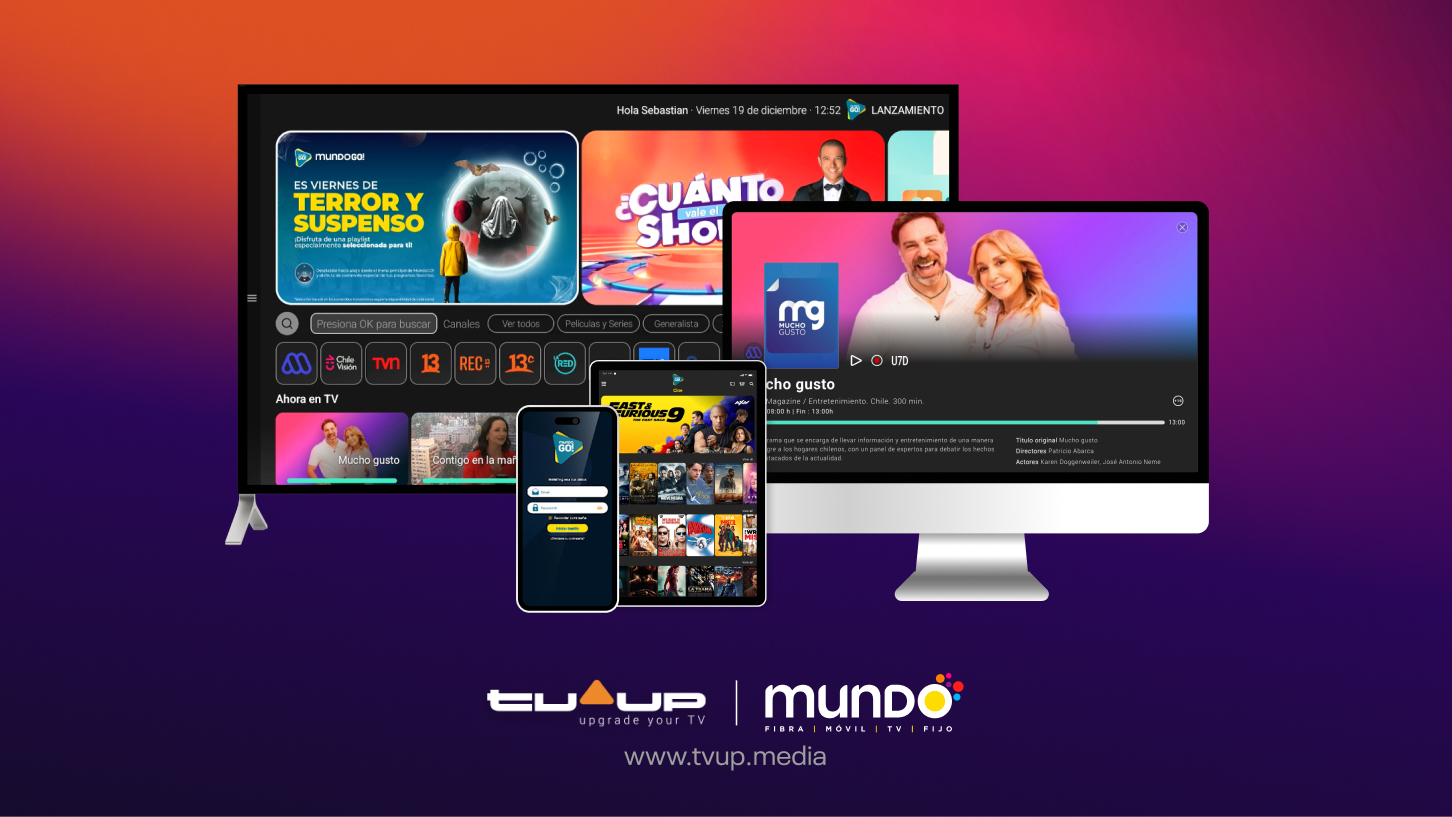
From a user experience perspective, Mundo Go! has been recognized by ProCalidad, Chile’s leading independent customer satisfaction benchmark, as the best pay TV service for two consecutive years. This recognition validates the robustness and consistency of the OTT experience delivered on TVUP’s platform.
Impact
Beyond quantitative indicators, the impact of the project is structural. Television moved beyond a purely defensive role to become a strategic asset within the operator’s business model. Thanks to the scalability and flexibility of the TVaaS model, Mundo Pacífico was able to align the evolution of its TV service with territorial growth and network deployment, without introducing additional operational complexity.
TVUP’s platform helped consolidate television as a central element of the operator’s convergent offering, strengthening customer loyalty and increasing the perceived value of the service. At the same time, it laid the foundations for continuous product evolution, ready to incorporate new services, consumption models, and progressive experience improvements.
From an industry perspective, this case demonstrates that television remains a relevant asset when built on a robust, scalable, and user-centric OTT architecture. In this context, TVUP acts not only as a technology provider, but as a strategic enabler, capable of turning technology into a real lever for growth even in contracting markets.
Conclusions
The Mundo Pacífico case highlights that pay TV can continue to play a meaningful role even in adverse market conditions. The key lies not merely in the presence of television as a product, but in how it is designed, how it evolves, and how it is integrated into the operator’s business model.
When television is built on a scalable, flexible, and user-focused OTT platform, it ceases to be a legacy burden and becomes a strategic asset with genuine growth potential.